The Knightsbridge palace — 330 departments, Egyptian escalators, trading since 1849. On 16 November 1898 Harrods debuted England's first 'moving staircase' (escalator) in the Brompton Road store.
Best for World's most famous luxury store
Charles Henry Harrod's grocery, founded in 1849, grew into the Knightsbridge palace whose terracotta façade, lit by thousands of bulbs at night, is London retail's most famous silhouette. Harrods' scale remains its argument — over a million square feet, the legendary Food Halls with their Edwardian tiles at the center, luxury floors covering every category, and services that once honored the motto Omnia Omnibus Ubique: all things for all people, everywhere. The store installed one of the world's earliest escalators in 1898, reportedly offering brandy to nervous riders at the top. Under Qatari ownership the store has been progressively polished into a luxury destination anchored by its beauty halls and designer floors. The Food Halls remain the essential visit: architecture, provisioning, and theatre in one room, and the house-label hampers and teas make the canonical London gift.
Enter through the Food Halls door on Hans Crescent to meet the store at its best first; the house-label teas and hampers remain the purchases that age well.
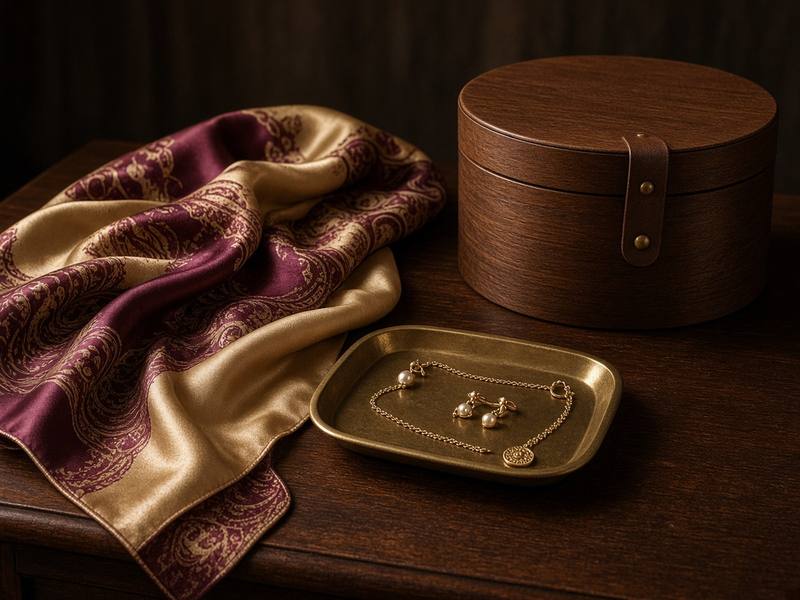
Liberty's London department store brings printed fabrics and clothing together with beauty products and home furnishings. The business began in 1875, when Arthur Lasenby Liberty opened his first shop on Regent Street. Its later Great Marlborough Street building uses reclaimed ship timbers within the department store's Tudor revival design.
Best for Printed fabrics and department-store browsing in London
Liberty began on Regent Street in 1875, when Arthur Lasenby Liberty opened a shop selling goods from abroad. Japanese objects and fabrics helped establish the business's interest in design beyond the British market. Its development became closely associated with the decorative arts through textiles and the emerging Art Nouveau movement.
The later Great Marlborough Street building opened in 1924, designed by Edwin T. Hall and Edwin S. Hall. Reclaimed timbers from ships supplied material for its Tudor revival construction, including wood used within the store. That building belongs to a later chapter than the founding shop on Regent Street.
Today the London store sells clothing and beauty products alongside home furnishings and its own printed fabrics. A fabric purchase and a department-store visit therefore offer different ways into the same business. For someone making clothes or furnishing a room, the textile range provides a more specific starting point than general gift browsing. Clothing and home departments broaden the visit for shoppers who are choosing finished pieces instead of fabric.
Harry Gordon Selfridge’s 1909 theatre of retail — the Oxford Street innovator that invented shopping as entertainment. Opening day drew 90,000 visitors; first-week visits topped one million. Westminster Gazette (1909): aim to make shopping 'a pleasure, a pastime, a recreation'.
Best for Iconic department store
Harry Gordon Selfridge, an American retail showman, opened his Oxford Street store in 1909 with a philosophy that changed shopping itself: goods out on display to be touched, staff trained to assist rather than pressure, the store as public theatre — he is credited with the phrase 'the customer is always right' and put Blériot's cross-Channel monoplane on display days after the flight. The columned building runs a full block and remains London's second-largest store. Modern Selfridges earned its own reputation as the most inventive of the world's department stores: the Yellow branding, ambitious themed campaigns filling the famous windows, the Corner Shop's rotating collaborations, and strong beauty, denim, and designer floors. The food hall and rooftop restaurants round it out. Visit for the windows and the energy — no London store works harder to make retail feel like an event.
Check what occupies the Corner Shop before visiting — the rotating concept space is where the store's invention concentrates, and it changes entirely by season.
 Visit official site ↗
 Visit official site ↗
 Visit official site ↗
 Visit official site ↗