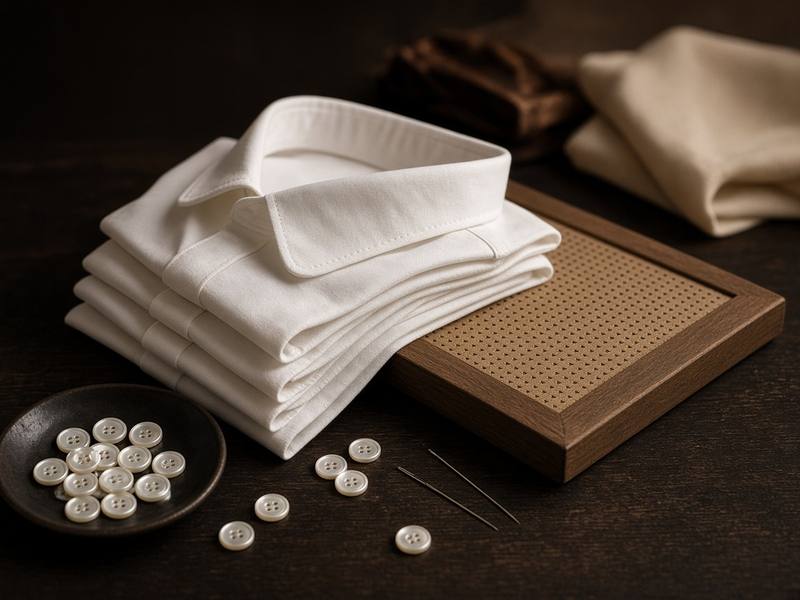
ORBISSHIRTMAKERS IN NEW YORK 9 shops in the atlas.Illustration
Shirtmakers in New York
9 stores · curated ORBIS register
Blank Label offers custom shirts through an online configurator, including a one-piece collar among the available design options. Bonobos uses showroom appointments to help customers choose fit, with orders forming part of the Guideshop model. J. Press brings Ivy-style oxford shirts into the selection, continuing a clothing house founded near Yale in 1902.
American custom shirtmaker — online configurator with one-piece collar as a standard option. Made-to-measure and custom fits.
Best for American custom one-piece collar shirts
Blank Label was founded in Boston in 2008 by Danny Wong, Zeeshan Sheikh and Fan Bi, then a Babson College student who left school in 2009 to build the company full time. It launched as an online-only custom-shirt maker, letting customers configure fit, fabric and details, collar style, plackets, monograms, through a web-based tool rather than a traditional made-to-measure appointment. The founders initially pitched the brand at a young, style-forward customer, but usage data showed their actual buyers skewed toward white-collar professionals in their late thirties, and the company repositioned around that clientele.
To address the limits of a purely digital fitting process, Blank Label opened its first physical "pattern room" in Boston in 2013, giving customers an in-person fitting that fed back into their saved online pattern for future orders. The company later expanded from shirts into custom suits and other made-to-order menswear, continuing to operate primarily through its online configurator backed by physical fitting locations.
In January 2024, Blank Label's run as an independent brand ended: it merged with Black Lapel and Ratio Clothing, folding into the Black Lapel brand as part of a stated combination of "over 50 years of collective expertise" in custom clothing. Former Blank Label customer accounts were migrated to Black Lapel's platform.
Bonobos sells menswear through fit-focused trousers, shirts, suits and casual clothing, supported by showroom appointments. Guideshops emphasise trying sizes and ordering rather than carrying every item for immediate take-away.
Corridor is the independent New York label Dan Snyder started in 2013 while sewing in the Garment District. It makes original textiles and clothing shaped by folk Americana, produced with family-run workshops, and covers shirts, knitwear, outerwear, footwear. Four shops trade in New York, including 245 Elizabeth Street in Nolita, with three more in Los Angeles. Design stays in Brooklyn, where the brand is based.
Best for Original textiles, shirts and knitwear designed in Brooklyn
Corridor began in 2013, when Dan Snyder was sewing in the Garment District and working out of a walk-up apartment in the East Village. The name comes from the Northeast Corridor bus line he rode at the time. The label describes itself as Brooklyn based and independent, drawing on folk Americana, and it makes original textiles rather than buying finished cloth. Production runs through family-run workshops in several countries, which the brand names as a deliberate choice rather than a sourcing note. The collection covers shirts, knitwear, outerwear, sweats, trousers, footwear. Accessories and a small homeware line sit alongside. Corridor also keeps a bookshelf section, which reads as an extension of the same interests in art and music. Seven shops are listed. Four sit in New York, at 245 Elizabeth Street in Nolita, 165 Dekalb Avenue in Fort Greene, 322 Bleecker Street in the West Village and 145 Wythe Avenue in Williamsburg. Three more are in Los Angeles, on North Larchmont Boulevard, California Avenue in Venice and Echo Park Avenue. Appointments can be booked at each address, and the brand still lists its design work as happening in Brooklyn.
Faherty is a clothing brand founded by twin brothers Mike and Alex Faherty, whose beach upbringing informs its casual style. The range includes shirts and knitwear alongside trousers and dresses, with accessories available for women and men. Its website also describes collaborations with Native designers, which should be distinguished from the wider clothing collection.
Best for Casual clothing and beach-influenced everyday layers
Faherty is a family-owned clothing brand established in 2013. Its official story presents the business through casual clothing for adults and children, supported by swim and accessories plus a home-goods line. Several programmes give the assortment a wider structure. Native Designed identifies collaborations with Native artists, while Second Wave Resale keeps existing Faherty pieces in circulation. The company also maintains partnership and sustainability alongside social-impact sections that sit beside its product catalogue. Clothing is organized around recurring wardrobe categories such as shirts and knitwear as well as trousers. Dresses and outerwear complete the wardrobe. Named groups including the Western Collection, Rugged Ivy Collection and Reserve Collection provide a more specific design direction within that everyday framework. Stretch Terry and movement-oriented shirts emphasize comfort and repeated wear rather than formal novelty. These facts make the brand's position legible: it builds a broad casual wardrobe, then uses partnerships and resale to add authorship and a second life to selected pieces. The family ownership and 2013 starting point provide the business context, while the named collections and programmes show how Faherty differentiates its clothing from a generic multi-category apparel offer.
Ivy League clothier founded in 1902 near Yale's campus by Jacobi Press, credited with popularizing the natural-shoulder 'sack suit' and Shaggy Dog shetland sweater. NYC flagship sits by the Yale Club at 51 E 44th St; second shop at 501 Madison Ave.
Best for True Ivy oxford shirts.
J. Press was founded in 1902 in New Haven, Connecticut, by Jacobi Press, a Latvian immigrant who partnered with local tailor Herman Goldbaum to open a shop serving Yale's undergraduates. The company became closely associated with the 'Ivy League look' - natural-shoulder, undarted sack suits, Harris Tweed jackets, flap-pocket oxford shirts, and reversible balmacaan coats. By the 1920s the shop's reputation extended to cultural figures including Cary Grant and Duke Ellington. J. Press also built a second life in Japan: its clothing appeared in the 1965 photo book 'Take Ivy,' fueling a decades-long 'Ametora' fashion obsession there. In New York, the brand's flagship operates at 51 East 44th Street, across from Grand Central Terminal, with a second shop at 501 Madison Avenue.
Proper Cloth covers shirts, casual trousers and tailoring under its fit guarantee. If the first result is wrong, customers can request a free remake in another size, fabric or style rather than settle for alterations alone.
Wythe makes menswear drawing on American sportswear, including oxford shirts and denim shirts with pearl-snap fastenings. Peter Middleton launched the label before its first physical shop opened on Orchard Street in 2023. Some overcoats use Donegal tweed and are made in New York, a product-specific statement rather than a collection-wide origin.
Best for Americana-inspired shirts and outerwear in New York
Wythe began with Peter Middleton's interest in familiar American garments, including oxford shirts and denim pearl snaps. The label's account describes looking back at older examples of those clothes while developing its own versions. Shirts and sweatshirts therefore provide a practical starting point for understanding the range beyond its general Americana references.
The business first traded online before opening a physical shop at 59 Orchard Street in 2023. That opening gave the label a New York retail address where its own collection could be presented together. Earlier reporting on the company concerns its launch period and the difficulties of building the business during that time.
Outerwear adds another strand to the collection, including overcoats made in New York's Garment District from custom Donegal tweeds. The weaving and garment-making locations describe different stages of production, rather than competing claims about one place. They also apply to those coats, not automatically to every shirt or accessory sold by the brand. A purchase should therefore be considered at the level of the particular garment and its stated construction.
 Visit official site ↗
 Visit official site ↗
 Visit official site ↗
 Visit official site ↗
 Visit official site ↗
 Visit official site ↗
 Visit official site ↗
 Visit official site ↗